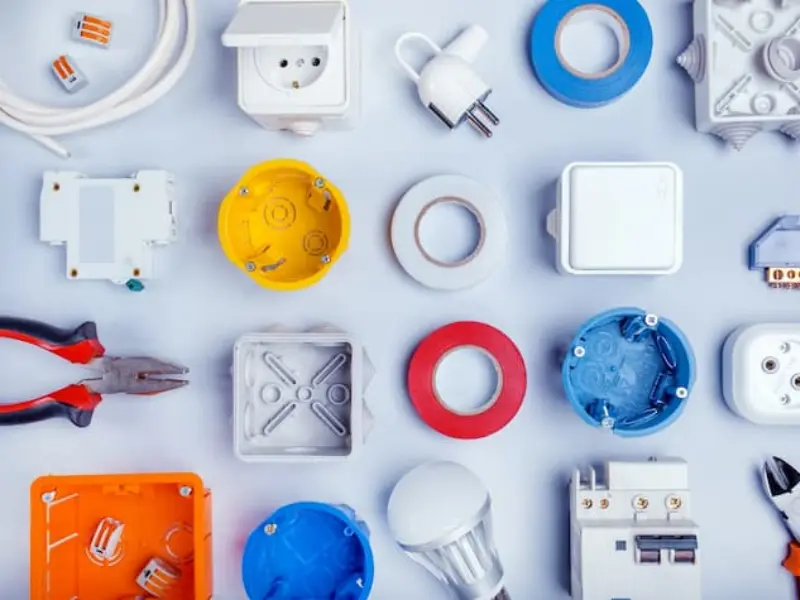
Electrical hardware is essential in every power system. It controls electricity, protects equipment, and connects different parts of a circuit.
From small buildings to large industrial projects, electrical hardware plays a key role in safety and performance.
- Types of electrical hardware
- Main products like circuit breakers and relays
- Components of electrical systems
- Basic electrical tools and accessories
Types of Electrical Hardware
There are many types of electrical hardware. Each type has a specific function.
Circuit Breakers
Circuit breakers are protection devices.
- Stop power during overload
- Prevent damage
- Improve safety
Used in:
- Distribution panels
- Industrial systems
- Homes and offices
Contactors
Contactors control high-power circuits.
- Used for motors
- Remote control operation
- High durability
Relays
Relays are switching devices.
- Control signals
- Automatic operation
- Used in automation systems
Switches
Switches control electrical flow manually.
- Turn power on/off
- Simple and reliable
- Used in all systems
Terminal Blocks
Terminal blocks connect wires.
- Safe connection
- Easy installation
- Organized wiring
Distribution Boxes
Distribution boxes manage power.
- Central control
- Protect circuits
- Used in buildings
Electrical Hardware Types Table
| Product | Function | Application |
|---|---|---|
| Circuit breaker | Protection | Power systems |
| Contactor | Control | Motors |
| Relay | Switching | Automation |
| Switch | On/off control | General use |
| Terminal block | Wire connection | Panels |
| Distribution box | Power distribution | Buildings |
Electrical Hardware Specifications
Different projects need different specifications.
Specification Table
| Product | Voltage Range | Current Range | Mounting Type |
|---|---|---|---|
| Circuit breaker | Low to high | Small to large | DIN rail/panel |
| Contactor | Medium/high | Medium/high | Panel mount |
| Relay | Low | Low | Plug-in |
| Switch | Low | Low/medium | Wall/panel |
| Terminal block | Low/medium | Low/medium | DIN rail |
| Distribution box | Low/high | Medium/high | Wall mount |
Applications
Electrical hardware is used in many industries.
Application Areas
- Construction projects
- Industrial automation
- Power distribution systems
- Renewable energy systems
- Infrastructure development
- Commercial buildings
Different Product Types We Supply
Our factory can supply many types of electrical hardware. We support different markets and applications.
Protection Equipment
Includes circuit breakers and safety devices.
- Stable performance
- Long service life
- High safety level
Control Equipment
Includes contactors and relays.
- Accurate control
- Suitable for automation
- Reliable operation
Connection Equipment
Includes terminal blocks and connectors.
- Easy wiring
- Safe connection
- Flexible design
Distribution Equipment
Includes distribution boxes and panels.
- Centralized control
- Strong protection
- Suitable for buildings
Product Range Table
| Category | Product Type | Features |
|---|---|---|
| Protection | Circuit breaker | Safety, overload protect |
| Control | Contactor, relay | Automation control |
| Connection | Terminal block | Easy wiring |
| Distribution | Distribution box | Power management |
What are the Components of Electrical Hardware?
Every piece of electrical hardware is made of specific parts that work together. Understanding these components helps in maintenance and troubleshooting.
Internal Components
- Conducting Path: This is usually made of copper or brass. It allows the electricity to flow through the hardware.
- Contacts: These are the points where the circuit opens or closes. They are often coated in silver to prevent corrosion.
- Insulation: Plastic or ceramic parts that prevent the electricity from “leaking” to the outside.
- Springs: These provide the force needed to snap a switch shut or open it quickly.
External Components
- Housing/Casing: The outer shell that protects the internal parts.
- Mounting Rail: Many parts are designed to clip onto a 35mm DIN rail.
- Labels: These show the voltage (V) and current (I) ratings.
What are 5 Electrical Tools?
To install electrical hardware properly, you need the right tools. Here are five essential tools used by electricians.
- Wire Strippers: Used to remove the plastic insulation from wires without damaging the metal core.
- Multimeter: A digital device used to measure voltage (V), current (A), and resistance (Ω).
- Insulated Screwdrivers: These protect the user from electric shocks while tightening terminals.
- Crimping Tool: Used to attach connectors to the ends of wires.
- Voltage Tester: A simple tool to check if a wire is “live” (has electricity) before you touch it.
What are the Basic Electrical Accessories?
Accessories are the “extra” parts that make an installation complete. They are just as important as the main hardware.
- Cable Ties: Used to bundle wires together for a clean look.
- DIN Rails: Metal tracks used to mount circuit breakers and relays inside boxes.
- Conduit and Fittings: Tubes that protect wires as they run along walls.
- Wire Ferrules: Metal tubes crimped onto the end of stranded wire to ensure a good connection in a terminal.
- Identification Tags: Small labels used to mark which wire goes to which machine.
Our Factory Capabilities
Our factory is a leader in the production of electrical hardware. We do not just sell products; we provide solutions. Here is what we offer:
Professional Manufacturing
We use high-precision machines to ensure every part is identical. Our quality control team tests every batch of circuit breakers and contactors. We check for:
- Heat resistance.
- Mechanical durability.
- Electrical conductivity.
Customization and Design
Do you need a specific size for your distribution box? Or a contactor with a unique voltage? We can help. Our engineers can modify existing designs to meet your specific needs. We support OEM (Original Equipment Manufacturer) services.
Global Standards
Our hardware is built to meet international safety standards. This ensures that our products can be used in any country. We focus on:
Durability: Making sure the hardware lasts for many years.
Safety: Reducing the risk of fire.
Efficiency: Minimizing energy loss in the hardware.
Why Choose Our Electrical Hardware
- High quality materials
- Stable performance
- Competitive pricing
- Flexible customization
- Professional support
We provide solutions for both small and large projects.
What is Electrical Hardware?
Electrical hardware includes all physical parts used in electrical systems.
It helps to:
- Control electrical flow
- Protect circuits
- Connect wires and devices
- Distribute power
Electrical hardware is widely used in:
- Residential buildings
- Commercial projects
- Industrial systems
- Energy and power plants
Electrical hardware of Modern Electrical Systems
Electrical hardware is the foundation of modern electrical systems.
From circuit breakers to distribution boxes, each component plays an important role.
Choosing the right electrical hardware types helps improve:
- Safety
- Efficiency
- System reliability
A professional factory can provide complete solutions for all applications.
Frequently Asked Questions
Q: How do I choose the right circuit breaker?
A: You must calculate the total load in Amps (I). The breaker rating should be slightly higher than the load but lower than the wire’s maximum capacity.
Q: Can I use residential hardware in a factory?
A: It is not recommended. Industrial environments have higher heat, vibration, and dust. You should use hardware specifically rated for industrial use.
Q: What is the benefit of a silver contact?
A: Silver has very low resistance. It prevents the contact point from getting too hot when the switch is closed.