In the world of machinery and construction, bearings are small but mighty components. If something spins, rotates, or moves smoothly, it likely uses a bearing. Without them, machines would create too much heat and friction, causing them to break quickly.
Our factory specializes in manufacturing high-precision bearings for various industries. We provide durable solutions that help your equipment run longer and more efficiently.
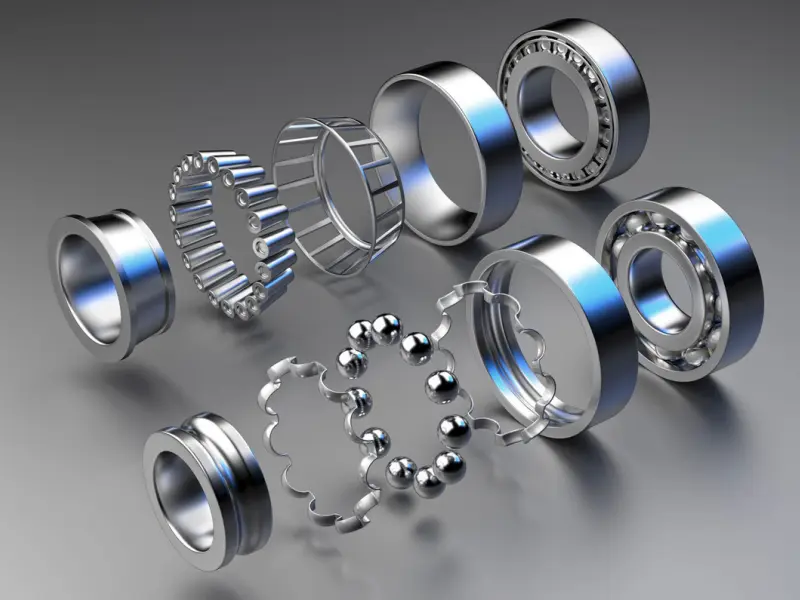
What are Bearings Used For? The Main Functions
The primary job of a bearing is to reduce friction between moving parts. Here are the three main reasons why we use them:
- Reducing Friction: Metal rubbing against metal creates heat. Bearings use balls or rollers to allow surfaces to “roll” instead of “slide.”
- Supporting Loads: Bearings hold the weight of a rotating shaft. This can be a vertical weight (axial load) or a side-to-side weight (radial load).
- Positioning Moving Parts: Bearings keep the internal parts of a machine in the correct place. This prevents parts from wobbling or vibrating.
Different Types of Bearings and Their Uses
Different machines need different types of movement. Below are the most common types of bearings we produce in our factory.
1. Deep Groove Ball Bearings
These are the most popular type. They have a simple design and can handle both radial and some axial loads.
- Best For: Electric motors, household appliances, and small power tools.
- Key Feature: High speed and very low noise.
2. Tapered Roller Bearings
These have cone-shaped rollers. They are designed to handle very heavy loads from multiple directions.
- Best For: Car wheels, gearboxes, and heavy construction machinery.
- Key Feature: Extremely strong and durable under pressure.
3. Thrust Bearings
These are designed specifically for “thrust” (axial) loads. They do not handle side loads well.
- Best For: Rotating chairs, steering systems, and vertical shafts.
- Key Feature: Smooth rotation for parts that sit on top of each other.
4. Spherical Roller Bearings
These can handle misalignment. If a shaft is slightly tilted, these bearings will still work perfectly.
- Best For: Mining equipment, paper mills, and heavy industrial fans.
- Key Feature: Self-aligning and very tough.
Technical Specifications Table
Our factory produces bearings in many sizes. Below is a table showing some of our standard digitized types and their technical specifications.
| Bearing Model | Inner Diameter (d) | Outer Diameter (D) | Width (B) | Basic Dynamic Load |
|---|---|---|---|---|
| 608 (Miniature) | 8 mm | 22 mm | 7 mm | 3.3 kN |
| 6204 (Standard) | 20 mm | 47 mm | 14 mm | 12.7 kN |
| 6306 (Heavy Duty) | 30 mm | 72 mm | 19 mm | 26.7 kN |
| 30205 (Tapered) | 25 mm | 52 mm | 16.25 mm | 32.5 kN |
| UC205 (Pillow Block) | 25 mm | 52 mm | 34.1 mm | 14.0 kN |
Common Materials Used in Bearing Manufacturing
The material determines how long a bearing will last in different environments. We offer several material options:
- Chrome Steel (GCr15): This is the standard material for most industrial bearings. It is very hard and wear-resistant.
- Stainless Steel (440C/304/316): Perfect for food processing or marine environments because it does not rust easily.
- Ceramic (Si3N4 / ZrO2): Used for ultra-high-speed applications or where electricity might pass through the bearing.
- Plastic: Light-duty bearings used in office equipment or wet environments where metal cannot be used.
Application Areas for Bearings
Where will you find our products? Almost everywhere! Here are the key application areas:
- Construction Industry: Used in excavators, cranes, and cement mixers to handle heavy loads.
- Automotive Industry: Found in wheel hubs, transmissions, and alternators.
- Agriculture: Used in tractors, harvesters, and irrigation pumps.
- Power Tools: Found in drills, saws, and grinders for smooth high-speed rotation.
- Home Appliances: Used in washing machines, vacuum cleaners, and ceiling fans to keep them quiet.
- Medical Equipment: High-precision bearings for dental drills and X-ray machines.
How to Choose the Right Bearing?
When you order from our factory, you should consider three main factors:
1. The Load Type
Will the weight push from the side (radial) or from the end (axial)? Ball bearings are good for light radial loads. Roller bearings are better for heavy radial loads.
2. The Operating Speed
Bearings have a speed limit measured in RPM (Rotations Per Minute). High-speed machines need precision ball bearings with special lubrication.
3. The Environment
- Dusty areas: You need sealed bearings (marked as 2RS) to keep dirt out.
- Wet areas: You need stainless steel bearings or special coatings to prevent rust.
- High heat: You need high-temperature grease and special internal clearances (like C3 or C4).
Factory Direct: Why Work With Us?
Our factory focuses on quality and customization. We provide the “moving heart” for your machines.
- Advanced Testing: We test every batch for noise, vibration, and hardness.
- OEM Services: We can laser-mark your brand name and produce custom sizes.
- Precision Manufacturing: Our tolerance levels meet international P6 and P5 standards.
- Large Stock: We keep thousands of 6000 series and 6200 series bearings ready for fast shipping.
Bearing Maintenance Tips
To make your bearings last longer, follow these simple steps:
- Keep them clean: Even a tiny grain of sand can destroy a bearing.
- Proper Lubrication: Use the right grease or oil. Too much grease can cause heat; too little causes wear.
- Correct Installation: Never hit a bearing directly with a hammer. Use a professional press tool.
- Listen for Noise: If a bearing starts to squeak or grind, it is time to replace it.
Comparison Table: Ball Bearings vs. Roller Bearings
| Feature | Ball Bearings | Roller Bearings |
|---|---|---|
| Friction Level | Very Low | Low |
| Load Capacity | Light to Medium | Heavy |
| Speed Capability | Very High | Medium |
| Common Use | Electric Motors | Truck Axles |
| Contact Point | Single Point | Line Contact |
Frequently Asked Questions (FAQ)
What does the “2RS” mean on a bearing?
It stands for “Two Rubber Seals.” This means both sides of the bearing are closed to keep grease in and dirt out.
How often should I lubricate my bearings?
This depends on the speed and heat. For most industrial machines, we recommend checking the lubrication every 6 to 12 months.
Can you produce custom-sized bearings?
Yes. Our factory can adjust the inner and outer diameters to fit your specific machinery design.
What is the difference between ZZ and 2RS?
ZZ means the bearing has metal shields. These are better for high heat. 2RS means rubber seals, which are better for keeping out water and dust.